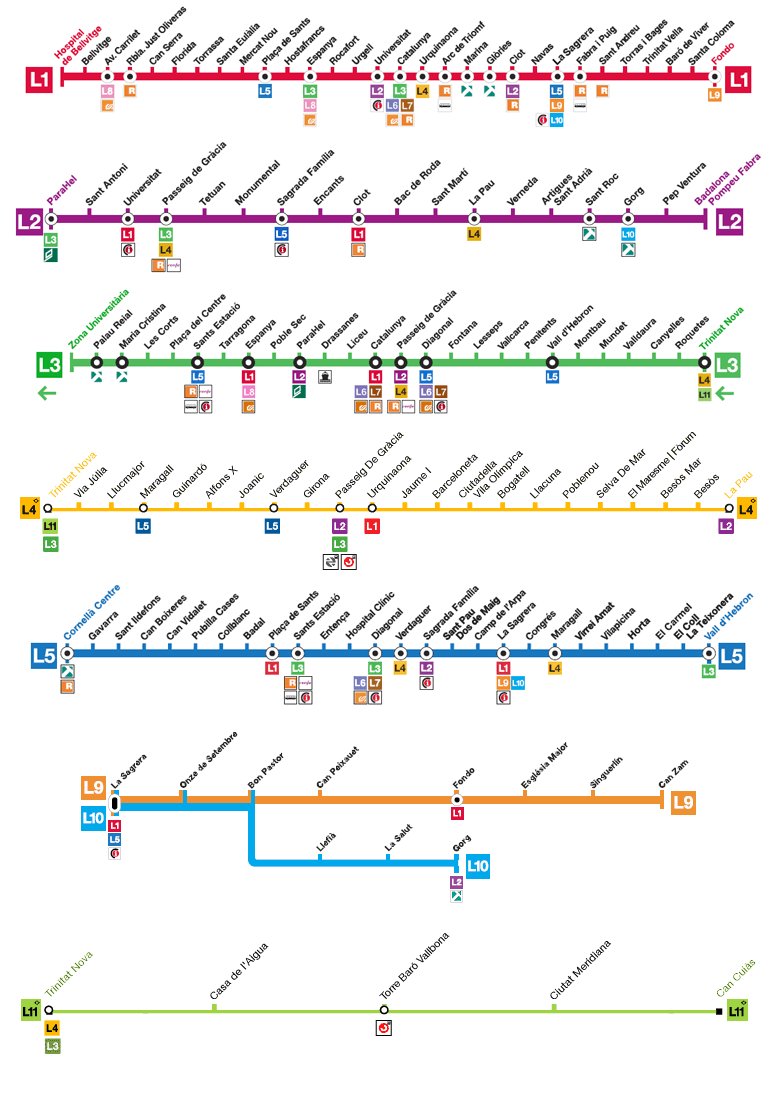
The Barcelona Metro is one of Europe's most comprehensive urban rail networks: 12 lines, over 180 stations and around 125 km of track operated by TMB and FGC. Opened on 30 December 1924, it carries nearly 480 million passengers a year. A single ticket costs €2.55 (zone 1, 2026) and the T-Casual 10-trip card €11.35. The L9 Sud line connects Terminals T1 and T2 of Barcelona Airport directly to the city centre (€5.90 airport supplement). The metro runs Monday to Thursday and Sunday 05:00–00:00, Friday and eve-of-holiday until 02:00, and Saturday continuously 24 hours.
| Barcelona Metro — key facts (2026) | |
|---|---|
| Lines | 12 (8 TMB + 4 FGC) |
| Stations | ~180 (integrated TMB + FGC network) |
| Network length | ~125 km (TMB network) |
| Opened | 30 December 1924 |
| Operators | TMB (L1–L5, L9, L10, L11) · FGC (L6, L7, L8, L12) |
| Passengers/year | ~480 million (2023) |
| Single ticket | €2.55 (zone 1, 2026) |
| T-Casual 10 trips | €11.35 (zone 1, 2026) |
| Airport supplement | +€5.90 (L9 Sud, terminals T1 and T2) |
| Operating hours | Mon–Thu & Sun: 05:00–00:00 · Fri & eve-of-holiday: 05:00–02:00 · Sat: 24 h |
| Website | tmb.cat · fgc.cat |
The 12 lines of the Barcelona Metro
The Barcelona Metro's integrated network comprises 12 lines and more than 180 stations. TMB (Transports Metropolitans de Barcelona) operates lines L1–L5 and L9–L11; FGC (Ferrocarrils de la Generalitat de Catalunya) operates L6, L7, L8 and L12. Fare integration is managed by ATM (Autoritat del Transport Metropolità), so a single ticket is valid across the entire network.
| Line | Colour | Terminal A | Terminal B | Stn. | Notes |
|---|---|---|---|---|---|
| L1 | Red | Hospital de Bellvitge | Fondo | 33 | TMB. First historic line (1924). Crosses city centre west–east. |
| L2 | Purple | Paral·lel | Badalona Pompeu Fabra | 18 | TMB. Opened 1995. Serves Sagrada Família and El Born. |
| L3 | Green | Zona Universitària | Trinitat Nova | 29 | TMB. Historic (1924). Las Ramblas, Passeig de Gràcia, Diagonal. |
| L4 | Yellow | La Pau | La Trinitat | 20 | TMB. Opened 1977. El Born, Barceloneta, Guinardó. |
| L5 | Dark blue | Cornellà Centre | Vall d'Hebron | 29 | TMB. Opened 1959. Sagrada Família, Verdaguer, Horta. |
| L6 | Violet | Plaça Catalunya | Reina Elisenda | 10 | FGC. Sarrià and Sant Gervasi neighbourhood. |
| L7 | Brown | Plaça Catalunya | Av. Tibidabo | 8 | FGC. Access to Tibidabo and Gràcia. |
| L8 | Pink | Plaça Espanya | Molí Nou – Molins de Rei | 13 | FGC. Southern metropolitan area. |
| L9N | Orange | La Sagrera-Meridiana | Can Zam / Gorg | 13 | TMB. Opened 2009. Northern sector. Driverless. |
| L9S | Orange | Aeroport T1 | Zona Universitària | 15 | TMB. Opened 2016. Airport connection. Supplement €5.90. |
| L10N | Sky blue | La Sagrera-Meridiana | Gorg | 11 | TMB. Opened 2010. Badalona north. Driverless. |
| L11 | Light green | Trinitat Nova | Can Cuiàs | 5 | TMB. Opened 2003. Short driverless branch, northern fringe. |
| L12 | – | Badalona Pompeu Fabra | Sant Adrià de Besòs | 3 | FGC. Opened 2023. New Badalona branch. |
Barcelona Metro fares and tickets (2026)
Since 2023–2024 the entire network uses the T-Mobilitat contactless payment system, which has permanently replaced the magnetic T10, T50/30, T70/30 and T-mes cards. Titles are loaded onto a free T-Mobilitat card or directly on a smartphone via NFC. Prices below are for zone 1 (Barcelona city).
| Ticket | Zone 1 price (2026) | Description |
|---|---|---|
| T-Casual (10 trips) | €11.35 | Replaces the T10. Personal, non-transferable. 1 h 15 min validity per trip with connections. |
| Single ticket | €2.55 | One journey. Useful for occasional use. |
| T-Usual (monthly) | ~€80 | Unlimited trips in zones 1–2 for 30 calendar days. |
| T-Jove (90 days) | ~€80 | Unlimited for under-30s. Valid 90 days. |
| T-Familiar | ~€10 | 8 trips shareable among members of the same household. |
| Hola Barcelona | from €17.50 | Tourist pass: 2, 3, 4 or 5 days of unlimited travel. Airport supplement not included. |
| Airport supplement | +€5.90 | Required at stations Aeroport T1 and Aeroport T2 (L9S). |
Indicative prices subject to annual revision by ATM. Always check the latest fares at tmb.cat.
Barcelona Metro operating hours
| Day | First train | Last train |
|---|---|---|
| Monday to Thursday | 05:00 | 00:00 (midnight) |
| Friday and eve-of-holiday | 05:00 | 02:00 |
| Saturday and eves of 1 Jan, 24 Jun, 15 Aug, 24 Sep | 24-hour continuous service | |
| Sunday and public holidays | 05:00 | 00:00 |
| 24 December | 05:00 | 23:00 |
Peak-hour frequency is 2–4 minutes on L1, L3 and L5, and 5–10 minutes on secondary and peripheral lines.
Getting to Barcelona Airport by metro
The L9 Sud line (orange) is the only direct metro link between Barcelona El Prat Airport and the city centre. It serves two airport stations:
- Aeroport T1 — Terminal 1 (Vueling, Iberia, British Airways, American Airlines, Lufthansa, Emirates and most long-haul flights).
- Aeroport T2 — Terminal 2 (some international carriers).
The journey from T1 to Zona Universitària (connection to L3 and L5 towards the centre) takes approximately 32 minutes. A mandatory €5.90 supplement must be paid on top of your regular travel card at airport stations.
Airport alternatives to the metro:
- Aerobús A1 / A2 — Direct bus T1 ↔ Plaça Catalunya (~35 min, ~€6.75, no supplement).
- Renfe Rodalies R2N — From Passeig de Gràcia or Barcelona Sants (~19 min). Integrated fare with T-Casual (no extra supplement).
- Bus 46 — Connects Aeroport T1 to Plaça Espanya. Cheapest option but slowest.
Top 10 stations for tourists
| Station | Line(s) | What's nearby |
|---|---|---|
| Sagrada Família | L2, L5 | Sagrada Família Basilica (Gaudí) |
| Passeig de Gràcia | L2, L3, L4 | Casa Batlló, Casa Milà (La Pedrera), Block of Discord |
| Catalunya | L1, L3 | Plaça Catalunya, start of Las Ramblas, El Corte Inglés |
| Liceu | L3 | Gran Teatre del Liceu, La Boqueria market, Las Ramblas |
| Barceloneta | L4 | Barceloneta beach, Olympic Port |
| Jaume I | L4 | Gothic Quarter, Cathedral, Museu d'Història de Barcelona |
| Diagonal | L3, L5 | Avinguda Diagonal, shopping, Palau de la Música |
| Paral·lel | L2, L3 | Montjuïc Funicular → Montjuïc Castle, Poble Sec |
| Espanya | L1, L3 | Fira Barcelona, MNAC, Palau Nacional, Montjuïc access |
| Arc de Triomf | L1 | Parc de la Ciutadella, Barcelona Zoo |
Ghost stations of the Barcelona Metro
Beneath Barcelona's streets there are several stations built but never opened to the public, or permanently closed:
- Gaudí (L5) — Constructed for the neighbourhood of the same name, but never put into service. Trains pass without stopping.
- Banc (L4) — Designed to serve the Gothic Quarter, it never opened.
- Correus (L4) — Planned next to the Port's main post office; also never opened.
- Rocafort (L1) — Was operational for a time but permanently closed.
- Avinguda de la Llum — A 1940s underground shopping arcade physically connected to the network; currently sealed.
History of the Barcelona Metro
Barcelona was the first city in Spain to have a metro. On 30 December 1924 the first stretch opened between Catalunya and Lesseps (today's L1), built by Gran Metropolitano de Barcelona. Two years later, in 1926, the Ferrocarril Metropolitano de Barcelona — ancestor of today's L3 — began operating, creating two parallel networks that ran independently for decades.
Both networks were unified under TMB (1982), which began fare integration. The 1966 Metro Plan drove systematic expansion with lines L4 and L5 and extensions of the existing routes.
The most ambitious project was the L9/L10 scheme, launched in the 2000s, with deep stations to minimise disruption in a dense urban environment. L9 Nord opened in 2009, but the northern and southern sections remain disconnected. L9 Sud — linking the airport — didn't open until July 2016. Completing the link between the two L9 segments remains the network's biggest outstanding project.
In 2023–2024 the transition to the T-Mobilitat contactless payment system was completed, permanently retiring magnetic-stripe cards.
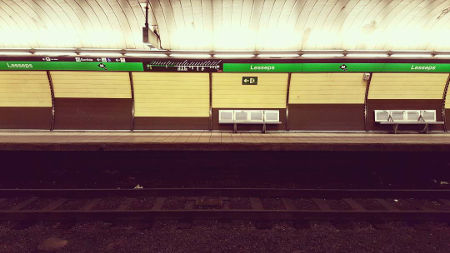 Barcelona Metro station
Accessibility and services
- Lifts and ramps: L9, L10 and L11 are fully accessible. Historic lines (L1, L3) are being progressively adapted; most stations now have lifts but some still do not.
- Bicycles: folding bikes are allowed at all times. Full-size bikes are permitted only at weekends and public holidays outside peak hours (not 07:00–09:30 or 17:00–19:00 on weekdays).
- Pets: dogs in carriers are permitted. Guide dogs have unrestricted access at all times.
- Driverless trains: L9, L10 and L11 operate fully automated with platform screen doors at all stations.
Safety tips for the Barcelona Metro
Barcelona has one of Europe's highest pickpocketing rates, particularly on the metro. Follow these tips:
- Carry your bag or backpack in front of you with zips closed, especially at busy stations: Catalunya, Passeig de Gràcia, Sagrada Família, Barceloneta.
- Don't take your phone out on platforms or leave it on the seat next to you.
- At turnstiles and escalators, keep your backpack in front of you.
- Use T-Mobilitat (contactless, no cash needed): reduces risk and means you don't carry paper tickets.
- TMB security staff and Guàrdia Urbana are present at the main tourist stations.
Other useful information
Fines for not validating: your ticket must be validated on each journey and transfer. Travelling without a valid validated ticket can result in a €100 fine (reducible to €50 if paid on the spot).
Lost property: if you lose something on the metro, contact TMB's customer service or go to a staffed station. Information number: +34 932 987 000.
Frequently asked questions about the Barcelona Metro
How much does the Barcelona Metro cost in 2026?
A single ticket costs €2.55 (zone 1). The T-Casual 10-trip card is €11.35 (€1.135 per trip). A mandatory €5.90 airport supplement applies for L9 Sud stations Aeroport T1 and T2.
What time does the Barcelona Metro open and close?
Monday to Thursday and Sunday: 05:00 to midnight. Friday and eves of public holidays: until 02:00. Saturday runs continuously 24 hours.
How many lines does the Barcelona Metro have?
The integrated network has 12 lines: L1, L2, L3, L4, L5, L9N, L9S, L10N and L11 (TMB) plus L6, L7, L8 and L12 (FGC). All share the T-Mobilitat payment system.
How do I get to Barcelona Airport by metro?
Take L9 Sud (orange) to Aeroport T1 or Aeroport T2 depending on your terminal. From Zona Universitària the journey takes ~32 minutes and requires a €5.90 supplement. A supplement-free alternative is the Renfe Rodalies R2N train from Passeig de Gràcia or Sants.
Is the T-Casual valid on buses and trams?
Yes. The T-Casual and all T-Mobilitat titles are valid on metro, TMB buses, FGC, tram (TRAM) and Rodalies within the same zone, with a transfer window of 1 hour 15 minutes.
Which travel card should tourists buy for Barcelona?
For short stays, the Hola Barcelona pass (from €17.50 for 2 unlimited days) is the most convenient. For a few days of moderate metro use, the T-Casual (10 trips, €11.35) is cheaper. Remember neither includes the airport supplement.
Update history
- May 2026 — Full revision: T-Mobilitat 2026 fares, 12 lines (L12 FGC added), updated line table, L9S airport connection, ghost stations, history, safety tips, FAQs and translations into 11 languages.
- November 2016 — Original article content.