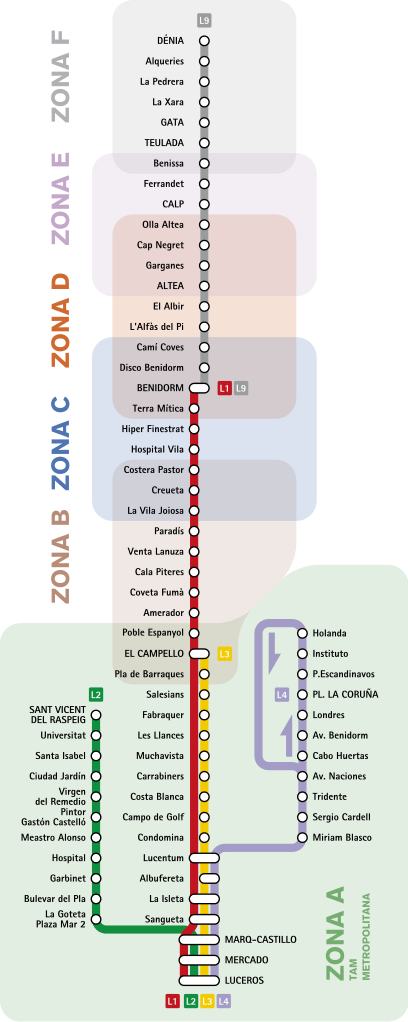
The TRAM d'Alacant is the Costa Blanca's main railway spine, connecting central Alicante with the University, San Juan Beach, El Campello, Benidorm, Altea, Calpe and Dénia. With 6 lines, 71 stations and 128 km of track, it operates as urban light rail underground in the city centre and as a coastal regional railway further out. It was the first system in Spain to run tram-trains, in 2007. Single fares start at €1.45; first trains before 6:00 AM on most lines.
TRAM d'Alacant: the railway system that defies classification
Most visitors to Alicante ask where the metro is. The honest answer: there isn't one in the traditional sense, but there's something more interesting. The TRAM d'Alacant — officially TRAM Metropolitano de Alicante, operated by FGV (Ferrocarrils de la Generalitat Valenciana) — is a hybrid system running simultaneously as urban light rail, street tram and regional coastal railway. Depending on which line you take, the experience changes completely: in the underground section beneath Alicante's city centre it feels like a modern metro; riding north towards Benidorm it transforms into a panoramic coastal train hugging the Mediterranean.
Opened on 15 August 2003 with the Alicante–El Campello corridor, the network has grown into the most significant rail system on the Alicante coast. It now counts 6 lines, 71 stations and 128 km of track, carried more than 18 million passengers in 2023, and links municipalities as different as Sant Vicent del Raspeig (university town), Benidorm (mass tourism) and Dénia (coastal village). Alicante was also the first Spanish city to operate tram-trains — vehicles capable of running on both urban tram tracks and conventional railway lines — when the system launched them in 2007.
One thing worth knowing upfront: the TRAM has real limitations. It doesn't serve the airport, frequencies outside the city drop to 30–60 minutes, and large parts of the Costa Blanca's dispersed urbanisations remain out of reach. But for specific journeys — the University, San Juan Beach, Benidorm, El Campello — it is clearly the best option available, and often the most enjoyable.
Key facts
| Feature | Data |
|---|---|
| Official name | TRAM d'Alacant / TRAM Metropolitano de Alicante |
| Operator | Ferrocarrils de la Generalitat Valenciana (FGV) |
| Owner | Generalitat Valenciana |
| Opened | 15 August 2003 |
| Number of lines | 6 (L1, L2, L3, L4, L5, L9) |
| Stations and stops | 71 |
| Network length | 128 km |
| Underground section | ~3.7 km in central Alicante (3 underground stations) |
| Annual passengers | More than 18 million (2023) |
| Minimum fare | €1.45 (single ticket, 1 zone) |
| General operating hours | Approx. 5:35 – 23:54 (varies by line) |
| Official website | tramalacant.es |
History: from mule-drawn trams to Spain's first tram-train
Alicante's first tram ran on 13 July 1893, pulled by mules. Electric traction came in 1924, and the network eventually connected Alicante with Muchamiel, Elche, Crevillente and Sant Vicent del Raspeig. For decades these trams were the backbone of urban mobility in the area. Then, as in most European cities, the car took over: the last tram ran in 1969, and Alicante spent the following decades almost entirely dependent on road transport.
The railway revival came in the late 1990s. Pilot services began in March 1999, and the modern TRAM officially opened on 15 August 2003 between Alicante and El Campello — 14 km and 13 stations. The Generalitat Valenciana's vision was ambitious: not a simple urban tram, but an integrated system combining tram, light rail and suburban railway in a single network.
In 2007 came the major leap, with the opening of Line L1 (Alicante–Benidorm) and Spain's first tram-train fleet (Series 4100), capable of running on both street-level tram tracks and conventional railway infrastructure. In June 2010 Luceros station opened after three years of underground construction, becoming the network's central hub. Line L2 (to the University) followed in 2013 with metro-style frequencies. In 2019 the coastal service from Puerta del Mar was restored as the new Line L5. And in January 2023, Line L9 between Benidorm and Dénia was fully restored after years of partial closure and bus replacement.
The 6 lines of the network
The main interchange is Luceros, where L1, L2, L3 and L4 converge. Mercado and MARQ-Castillo complete the underground section beneath Alicante's historic centre. From there, the lines fan out towards the coast, the university and the northern coastal corridor.
| Line | Colour | Route | km | Stations | Type | Opened |
|---|---|---|---|---|---|---|
| L1 | Red | Luceros ↔ Benidorm | 44.6 | 20 | Tram-train | 30/07/2007 |
| L2 | Green | Luceros ↔ Sant Vicent del Raspeig | 7.2 | 14 | Light rail | 04/09/2013 |
| L3 | Yellow | Luceros ↔ El Campello | 14.4 | 17 | Tram | 15/08/2003 |
| L4 | Purple | Luceros ↔ Plaza La Coruña | 14.6 | 18 | Tram | 15/06/2007 |
| L5 | Blue | Puerta del Mar ↔ Plaza La Coruña | 13.3 | 17 | Tram | 10/06/2019 |
| L9 | Grey | Benidorm ↔ Dénia | 50.9 | 18 | Regional rail | 16/01/2023 (full) |
Line L1 (red) — Luceros to Benidorm: the coastal tram-train
The longest line and the most popular with tourists. It runs 44.6 km from central Alicante to Benidorm Intermodal station in about 70–75 minutes, passing through El Campello, Villajoyosa and the Terra Mítica theme park. Frequency is every 30 minutes, with extra services in summer. The Series 4100 tram-trains (Vossloh) used on this line can reach 100 km/h on open track.
Stations (20): Luceros, Mercado, MARQ-Castillo, Sangueta, La Isleta, Lucentum, El Campello, Poble Espanyol, Amerador, Coveta Fumà, Cala Piteres, Venta Lanuza, Paradís, La Vila Joiosa, Creueta, Costera Pastor, Hospital Vila, C.C. La Marina - Finestrat, Terra Mítica, Benidorm.
Line L2 (green) — Luceros to Sant Vicent: the university line
The most urban line in the network, and the one that operates most like a conventional metro. Just 7.2 km and 14 stations, but with peak frequencies of 7–15 minutes, making it the backbone of daily commuting within Alicante. It serves the General Hospital, the Garbinet neighbourhood, Ciudad Jardín and the University of Alicante campus at Sant Vicent del Raspeig. With over 7 million trips per year, it is easily the busiest line in the system.
Stations (14): Luceros, Mercado, MARQ-Castillo, La Goteta-Plaza Mar 2, Bulevar del Pla, Garbinet, Hospital, Maestro Alonso, Pintor Gastón Castellón, Virgen del Remedio, Ciudad Jardín, Santa Isabel, Universitat, Sant Vicent del Raspeig.
Line L3 (yellow) — Luceros to El Campello: the original line
The oldest line in the modern system, opened in August 2003. It runs 14.4 km along the northern edge of Alicante Bay, passing the Albufereta beach, the Roman site of Lucentum, Muchavista beach and residential areas leading to El Campello. Popular with both residents of coastal urbanisations and day-trippers heading for quieter beaches. Frequency: every 30 minutes.
Stations (17): Luceros, Mercado, MARQ-Castillo, Sangueta, La Isleta, Albufereta, Lucentum, Condomina, Campo de Golf, Costa Blanca, Carrabiners, Muchavista, Les Llances, Fabraquer, Salesians, Pla Barraques, El Campello.
Line L4 (purple) — Luceros to Plaza La Coruña: the San Juan Beach line
Connects central Alicante with the San Juan Beach hotel and residential zone. Shares the underground section with the other lines, then runs along the northern coast past Cabo Huertas to Plaza La Coruña. Station names like «Países Escandinavos», «Holanda» and «Londres» (Scandinavia, Holland, London) are not accidental: they reflect where communities of Northern European expats historically settled in the San Juan coastal strip. Frequency: every 30 minutes.
Stations (18): Luceros, Mercado, MARQ-Castillo, Sangueta, La Isleta, Albufereta, Lucentum, Miriam Blasco, Sergio Cardell, Tridente, Av. Naciones, Cabo Huertas, Av. Benidorm, Londres, Plaza de La Coruña, Instituto, Países Escandinavos, Holanda.
Line L5 (blue) — Puerta del Mar to Plaza La Coruña: the direct coastal link
Opened in June 2019, L5 connects Alicante's port area (Puerta del Mar) directly with San Juan Beach without going through Luceros or the city centre. Particularly useful for passengers arriving by ferry who want to head straight to the beach, or for port-area residents who want to bypass the central interchange. It reuses the old short tram-shuttle that operated between 2003 and 2013. Frequency: every 30 minutes.
Stations (17): Puerta del Mar, La Marina, Sangueta, La Isleta, Albufereta, Lucentum, Miriam Blasco, Sergio Cardell, Tridente, Av. Naciones, Cabo Huertas, Av. Benidorm, Londres, Plaza de La Coruña, Instituto, Países Escandinavos, Holanda.
Line L9 (grey) — Benidorm to Dénia: the coastal railway
The most unusual line in the network and one of the most visually spectacular railways in Spain. Its 50.9 km run from Benidorm north through Altea, Calpe, Teulada and several inland villages to Dénia. Parts of the route feel genuinely like a historic Mediterranean railway — small stations, dramatic coastal scenery, cliffs and fishing villages. The Stadler Citylink Series 5000 vehicles used here are dual-mode (electric/diesel), allowing them to operate on both electrified and non-electrified sections.
Line L9 had a troubled history: partial closures, bus substitution services and delayed modernisation stretched over many years. Full service between Benidorm and Dénia was finally restored on 16 January 2023. Current frequency: every 60 minutes; full journey time approximately 75–80 minutes.
Stations (18): Benidorm, Disco Benidorm, Camí Coves, L'Alfàs del Pi, El Albir, Altea, Garganes, Cap Negret, Olla de Altea, Calpe, Ferrandet, Benissa, Teulada, Gata, La Xara, La Pedrera, Alqueries, Dénia.
The underground section: when the TRAM feels like a metro
Beneath central Alicante, 3.7 km of tunnels host three underground stations: Luceros (the main interchange), Mercado (near the Central Market) and MARQ-Castillo (access to the Castle of Santa Bárbara). A second tunnel under the Sierra Grossa hill — 1.4 km, opened December 2018 — significantly improved capacity between Sangueta and La Isleta, removing a long-standing bottleneck. In this section the TRAM operates exactly as a modern metro: covered platforms, ticket gates, information screens and high frequencies.
Rolling stock: three generations of vehicles
| Series | Manufacturer | Units | Capacity | Max speed | Traction | Main use |
|---|---|---|---|---|---|---|
| 4100 | Vossloh | 9 | 315 pax | 100 km/h | Electric 750 V | L1 (tram-trains, first in Spain) |
| 4200 | Bombardier Flexity | 22 | 277 pax | 70 km/h | Electric 750 V | L2, L3, L4, L5 (urban tram) |
| 5000 | Stadler Citylink | 6 | 303 pax | 100 km/h | Bi-mode (electric/diesel) | L9 (dual-mode for mixed track) |
| 2500 | MAN | 6 | 259 pax | — | Diesel | L9 (non-electrified sections) |
The Series 4100 tram-trains are historically significant: they were the first vehicles of their kind in Spain, able to switch seamlessly between urban tram tracks and conventional railway infrastructure. The Series 5000 Citylink (Stadler) dual-mode units on L9 allow operation regardless of electrification status — an unusual feature for what is nominally an urban system. Fleet maintenance is handled at the El Campello depot, opened in 2007 with 65,000 m² of facilities.
Timetables and frequencies
| Line | First train | Last train | Frequency | Notes |
|---|---|---|---|---|
| L1 | ~5:40 | ~22:11 | 30–60 min | Extra services to Benidorm in summer |
| L2 | ~5:35 | ~22:54 | 7–15 min (peak) / 15–20 min (off-peak) | Most frequent line in the system |
| L3 | ~6:15 | ~23:54 | 30 min | Latest last service |
| L4 | ~5:59 | ~22:35 | 30 min | Shares route with L3 to Lucentum |
| L5 | ~6:00 | ~22:30 | 30 min | Coastal route bypassing Luceros |
| L9 | ~5:50 | ~21:59 | 60 min | Full Benidorm–Dénia service since 2023 |
Not all services stop at every station. Weekend and holiday frequencies are reduced on some lines. Always check current timetables at tramalacant.es before travelling.
Special services
- TRAMnochador: On Friday and Saturday nights in July and August, the TRAM extends service until approximately 3:00 AM — ideal for returning from beaches or Benidorm's nightlife.
- Hogueras de San Juan (20–29 June): During Alicante's biggest local festival, the TRAM runs 24 hours non-stop — one of very few rail systems in Spain to do so during a local celebration.
Fares and tickets
The TRAM uses a zone-based fare system (1 to 5 zones) depending on journey distance. Check the zone map before buying your ticket — it is displayed at stations and on the official website.
Single tickets and returns
| Ticket type | 1 zone | 2 zones | 3 zones | 4 zones | 5 zones |
|---|---|---|---|---|---|
| Single | €1.45 | €1.90 | €2.45 | €2.95 | €3.55 |
| Return | €2.35 | €3.10 | €4.00 | €4.80 | €6.10 |
10-journey card (Tarjeta 10)
| Zones | Price | Per journey |
|---|---|---|
| 1 zone | €8.70 | €0.87 |
| 2 zones | €14.00 | €1.40 |
| 3 zones | €19.80 | €1.98 |
| 4 zones | €25.10 | €2.51 |
| 5 zones | €31.00 | €3.10 |
The 10-journey card is valid for 30 days from first use. Best value for frequent travellers or tourists planning multiple trips.
Tourist and monthly passes
| Pass | Price | Validity | Best for |
|---|---|---|---|
| Tourist 24h | €7.00 | 24 hours | Visitors making several trips in a day |
| Tourist 48h | €12.00 | 48 hours | Short 2-day stays |
| Tourist 72h | €16.00 | 72 hours | Weekend visits |
| Monthly pass (1 zone) | €37.00 | 30 days | Residents and commuters |
| Monthly pass (5 zones) | €84.70 | 30 days | Long-distance regular commuters |
| Tardeo ticket | €4.00 | 19:00 – 24:00 | Evening outings |
Reduced fares are available for senior citizens, students and people with disabilities. Documentation required at point of sale. Always verify current prices at the official website.
Practical tips for using the TRAM
- Buy before boarding at station machines or on board (single tickets only). The 10-journey card and passes are available at authorised sales points.
- Always validate on boarding, even with reloadable cards. Ticket inspections are frequent and fines significant.
- Check your zones: Alicante to Benidorm needs 5 zones. Alicante to El Campello, 2 zones. Zone maps are displayed at every station.
- Luceros is the hub: almost any journey combining two lines passes through here. It also has the most complete facilities (information, machines, access to all lines).
- For the University (L2): alight at «Universitat», not «Sant Vicent». The former is on campus; the latter is in the town centre.
- In summer, expect crowding: coastal lines (L1, L3, L4) fill up in July and August, especially towards beaches in the hottest part of the day.
- Official app: FGV has an app for Android and iOS with route planner and real-time timetables.
- SUMA card: the integrated transport card for Alicante Province allows combining TRAM with urban buses under a single fare system.
The airport: the system's most glaring gap
Alicante-Elche Miguel Hernández Airport is the eighth busiest in Spain, handling over 16 million passengers a year, yet it has no direct TRAM connection. This is the most common criticism of the system and one of its most practical limitations for visitors.
Options for reaching the city centre from the airport:
- Bus C-6 (ALSA): connects the airport with Alicante bus station. Cheapest option: about 25–30 minutes, around €3–4. Irregular frequency.
- Renfe Cercanías C-1: Alicante's main railway station (Estació del Nord) is within very short walking distance of the TRAM Luceros stop, so a Renfe connection + TRAM is viable.
- Taxi or rideshare: 10–15 minutes to the city centre, approximately €18–25.
Long-term integration plans linked to the future Central Station may eventually include an airport connection, but no confirmed timetable exists at present.
Accessibility
The TRAM has improved accessibility significantly. Series 4200 and 5000 vehicles are low-floor with automatic boarding ramps for wheelchairs and pushchairs. Underground stations have lifts and fully adapted access. Most surface stops have platform-level boarding. The system uses Navilens technology for visually impaired passengers: QR-style codes that, when scanned with a smartphone, provide audio information about the stop and the next departure. Magnetic induction loops for hearing aid users are installed at main stations.
The Series 4100 tram-trains used on L1 have a slightly higher floor, but dedicated elevated platforms at those stops compensate for this.
Safety
The TRAM has a generally good safety record, especially compared to larger urban networks. None of the lines run through areas with known safety issues. Ticket inspections are frequent, which also acts as a deterrent. In summer, the main practical problem on coastal lines isn't safety but overcrowding: trains fill rapidly on beach days, and boarding at intermediate stops in August can be difficult. Plan accordingly.
Key stations for visitors
| Station | Lines | What to see / do | Practical value |
|---|---|---|---|
| Luceros | L1, L2, L3, L4 | Shopping, hotels, city centre restaurants | Central hub — change lines here |
| Mercado | L1, L2, L3, L4 | Central Market, old town, El Barrio district | Food, local life, gastronomy |
| MARQ-Castillo | L1, L2, L3, L4 | Castle of Santa Bárbara, MARQ archaeology museum, port | Essential cultural visit |
| Lucentum | L1, L3, L4, L5 | Roman ruins of Lucentum, Albufereta beach | Archaeology and beach combined |
| El Campello | L1, L3 | Fishing port, beach, Torre Illeta | Quiet beach 25 min from Alicante |
| Universitat | L2 | University of Alicante campus | Direct campus access (55,000 students) |
| Terra Mítica | L1 | Terra Mítica theme park, Terra Natura zoo | Car-free access to the theme park |
| Benidorm | L1, L9 | Beaches, nightlife, Benidorm Palace | Main tourist destination on L1 |
| Altea | L9 | Medieval old town, seafront, art galleries | One of the most beautiful towns on the Costa Blanca |
| Calpe | L9 | Peñón de Ifach, La Fossa beach, fishing port | Spectacular views; perfect for a day trip |
| Dénia | L9 | Dénia Castle, port, ferry to Ibiza/Mallorca | Northern terminus; ferry port access |
The TRAM and the Costa Blanca: a system built for a dispersed coast
The Costa Blanca is geographically complex: a chain of coastal municipalities separated by dispersed urbanisations, with a tourist population in summer that multiplies travel demand exponentially. The TRAM doesn't solve this entirely — the car remains essential for many areas — but it provides a real alternative for the most-travelled coastal corridor.
What makes the system particularly interesting is its use by foreign residents. The Costa Blanca has one of the largest expat communities in Europe: British, Dutch, German, Belgian and Scandinavian residents who use the TRAM as their daily transport. The station names «Países Escandinavos» (Scandinavia), «Holanda» (Holland) and «Londres» (London) on L4 are not random: they mark where those communities historically settled. On the coastal section of L4 and L1 it's common to hear English, Dutch and German as much as Spanish.
Urban and territorial impact
The TRAM has driven measurable property value increases in areas with good station access, particularly along the L2 corridor within Alicante city. On the coast, railway accessibility has reinforced the residential appeal of El Campello and Villajoyosa for people working in Alicante who prefer a calmer lifestyle. It has also helped reduce road traffic on the Alicante–Benidorm corridor in summer, though the Costa Blanca remains heavily car-dependent overall.
Future projects: the transformation ahead
Central Intermodal Station
The most important project under construction. The future Alicante Central Station will create a major underground interchange connecting the TRAM with Renfe trains (including future high-speed services) and long-distance buses. FGV began excavation work in 2024, with a budget of approximately €100 million and a target completion of 2027–2028. When finished, it will transform intermodal travel in Alicante and allow passengers arriving by long-distance train to connect directly to the TRAM without surface-level transfers.
New Line L6
Planned to connect the future Central Station with the San Blas industrial zone and the Sant Vicent hospital area. Estimated budget: €40 million. Currently in project phase.
FGV Investment Plan 2030
In 2025, FGV announced an investment plan of €840 million to 2030 covering both the Valencia Metro and the TRAM d'Alacant. The Alicante allocation includes track modernisation, electrification of L9 sections, station upgrades and acquisition of new rolling stock to replace the oldest vehicles in the fleet.
Vega Baja and airport connection studies
Feasibility studies exist for extending the network southwards towards Orihuela and Torrevieja (Vega Baja), and eventually towards the airport. These remain long-term projects with uncertain timelines, dependent on funding decisions.
Interesting facts
- Alicante was the first Spanish city to run tram-trains, in 2007 — before any other network in the country.
- Luceros station took three years to build (2007–2010) due to geotechnical challenges beneath the historic city centre.
- Station names like «Países Escandinavos», «Holanda» and «Londres» on L4 reflect the historic settlement patterns of Northern European expats on San Juan Beach.
- Line L9 has sections where the train runs literally along clifftops with direct views over the Mediterranean, especially between Altea and Calpe.
- During the Hogueras de San Juan festival, the TRAM runs all night without stopping — one of the few rail systems in Spain to offer 24-hour service during a local holiday.
- The El Campello maintenance depot covers 65,000 m² — larger than many football stadiums.
- The Series 5000 (Stadler Citylink) vehicles on L9 are genuinely dual-mode: they switch between electric catenary and diesel engine depending on track electrification — uncommon in systems that also run urban trams.
How does it compare?
The TRAM d'Alacant most resembles Germany's hybrid Stadtbahn networks (particularly Karlsruhe, which pioneered the tram-train concept in Europe) rather than a conventional metro. It shares characteristics with Montpellier's metropolitan tram and some Dutch coastal light rail systems. What sets it apart is the combination of dense urban service and long-distance coastal leisure travel on the same network — few systems in Europe take you from a city centre to a tourist resort 50 km away in the same vehicle without changing.
Frequently asked questions
- How much does a TRAM ticket cost in Alicante?
- A single ticket costs between €1.45 (1 zone) and €3.55 (5 zones). The 10-journey card offers better value from €8.70 (1 zone). The 24-hour Tourist Pass costs €7.00 for unlimited travel. Prices may have changed; always check the official website.
- How do I get from Alicante airport to the TRAM?
- The TRAM does not serve Alicante-Elche Airport directly. Take bus C-6 (ALSA) to the bus station (25–30 min, approx. €3–4), or a taxi (around 15 min, €18–25). From Alicante's main railway station (Renfe), the TRAM is just a short walk away.
- Does the TRAM go to Benidorm?
- Yes. Line L1 (red) runs from Luceros to Benidorm in about 70–75 minutes. The route is 44.6 km with a frequency of every 30 minutes. Extra services operate in summer.
- What are the TRAM's operating hours?
- L1: approx. 5:40–22:11. L2: 5:35–22:54. L3: 6:15–23:54. L4: 5:59–22:35. L9: 5:50–21:59. On Friday and Saturday nights in July–August the TRAMnochador service extends to approximately 3:00 AM. During the Hogueras de San Juan festival (20–29 June), service runs 24 hours.
- Does the TRAM go to Dénia?
- Yes, via Line L9, which links Benidorm with Dénia in approximately 75–80 minutes (50.9 km, 18 stations, every 60 minutes). Full service was restored in January 2023 after years of partial closure. The route passes through Altea, Calpe and Teulada with spectacular coastal views.
- Is the TRAM accessible for passengers with reduced mobility?
- Yes. Modern trams (Series 4200 and 5000) are low-floor with automatic ramps. Underground stations have lifts. The system uses Navilens technology for visually impaired passengers and magnetic induction loops for hearing aid users.
- How many lines does the TRAM have?
- Six lines in service: L1 (Luceros–Benidorm, red), L2 (Luceros–Sant Vicent, green), L3 (Luceros–El Campello, yellow), L4 (Luceros–Plaza La Coruña, purple), L5 (Puerta del Mar–Plaza La Coruña, blue) and L9 (Benidorm–Dénia, grey). Total: 71 stations and 128 km.
Update history
- May 2026 — Full rewrite: L5 (operational since 2019), full L9 restoration (2023), updated passenger figures, future projects (Central Station, FGV 2030 plan), Series 5000 rolling stock, TRAMnochador and Hogueras services, Navilens accessibility.
- October 2024 — Fares and passes updated.
- February 2011 — Article created.