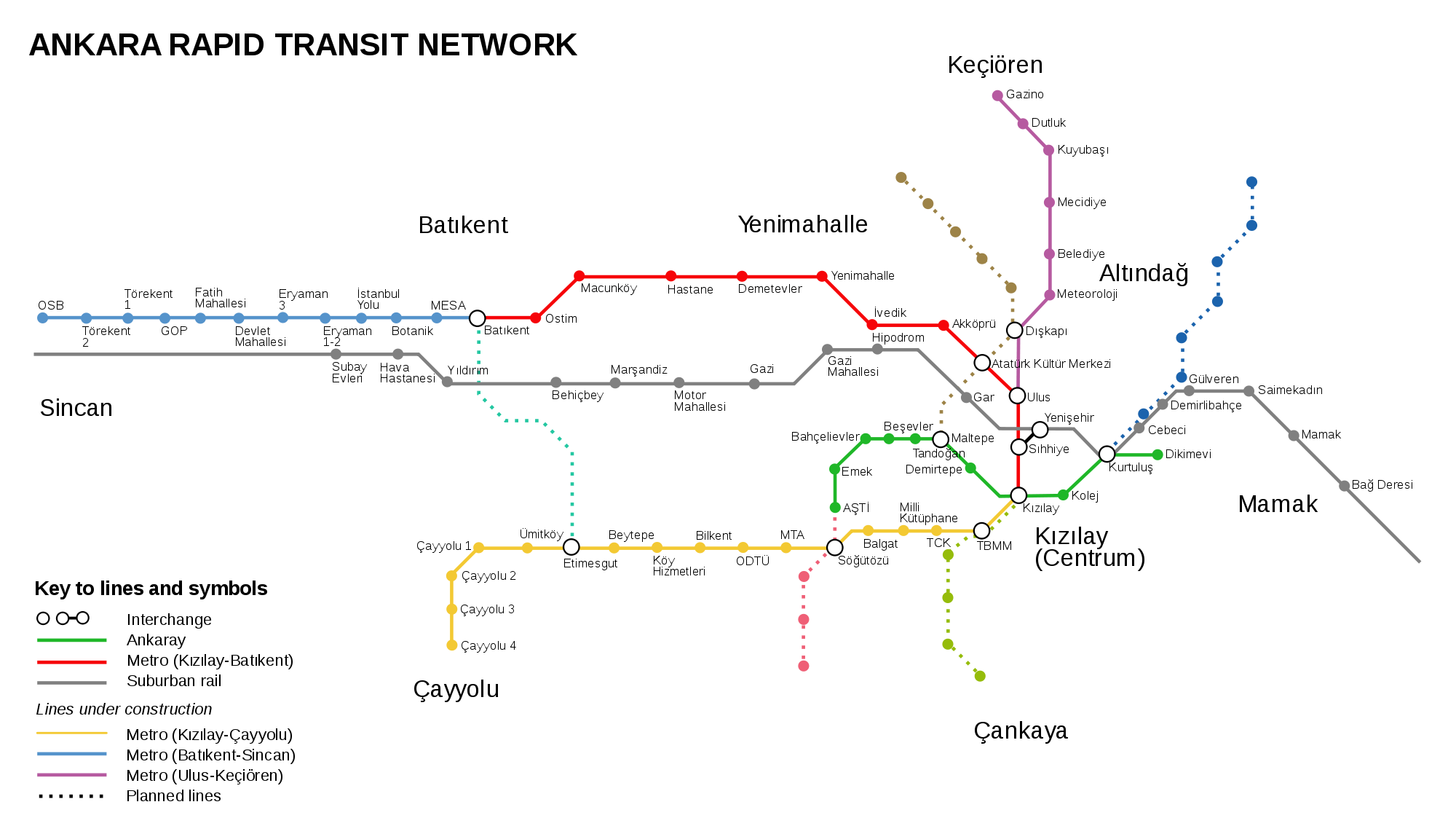
The Ankara Metro (Ankara Metrosu) is the urban rail network of Ankara, the capital of Turkey, operated by EGO Genel Müdürlüğü. The system includes four heavy metro lines (M1, M2, M3, M4) and the light metro Ankaray A1, covering a total of ~67 km with ~57 stations. Ankaray opened on 20 August 1996; the first heavy metro line (M1) followed on 29 December 1997.
Since 2019, lines M1, M2 and M3 run as a single through service between Koru and OSB/Törekent, with Kızılay as the central interchange. The fare with Başkent Kart / AnkaraKart is 35 TL (2026). Esenboğa Airport has no direct metro connection; the bus line 442 is the main public link; an airport metro line is planned with construction set to start in 2026.
| Official name | Ankara Metrosu |
|---|---|
| Operator | EGO Genel Müdürlüğü |
| Opened | 20 August 1996 (Ankaray) / 29 December 1997 (M1) |
| Lines | M1, M2, M3, M4 (heavy metro) + Ankaray A1 (light metro) |
| Stations | ~57 (including Ankaray) |
| Length | ~67 km (metro + Ankaray) / ~57 km (heavy metro only) |
| Operating hours | 06:00–00:00 approx. (varies by line and season) |
| Başkent Kart fare | 35 TL standard / 17 TL reduced / 41 TL bank card (2026) |
| Passengers (2024) | 172.1 million (133.5M metro + 38.6M Ankaray) |
| Official website | ego.gov.tr |
History of the Ankara Metro
Ankara is Turkey's administrative capital — home to Parliament, ministries, embassies, universities and hospitals. Daily commutes between Kızılay, Ulus, Çankaya, Batıkent, Keçiören, Bilkent and the major university campuses shape the city's mobility needs. Located at over 800 metres above sea level in Central Anatolia, Ankara's hilly topography directly influenced the design of its metro network.
Ankara's first modern urban rail system was Ankaray, inaugurated on 20 August 1996. This light metro line (A1) linked the AŞTİ intercity bus terminal with the Dikimevi area to the east via 11 stations over 8.53 km. Construction had begun in 1992.
Heavy metro arrived on 29 December 1997 with M1 Kızılay–Batıkent (12 stations, 14.66 km), built from 1993. In 2014, M2 (Kızılay–Koru, serving university campuses and Çayyolu) and M3 (Batıkent–Sincan/Törekent) both opened. From 2019, M1, M2 and M3 were integrated into a single through-running service between Koru and OSB/Törekent.
M4 connects Kızılay with Keçiören — one of Ankara's most densely populated districts — via Gar, AKM and Dışkapı. Its first section opened in 2017 and the extension through to Kızılay was completed in 2023, creating a direct link with the central interchange.
Lines
| Line | Route | km | Stations | Opened | Colour |
|---|---|---|---|---|---|
| M1 | Kızılay ↔ Batıkent | 14.66 | 12 | 29 Dec 1997 | Red |
| M2 | Kızılay ↔ Koru (Çayyolu) | 16.59 | 10 | Mar 2014 | Yellow |
| M3 | Batıkent ↔ OSB/Törekent | 15.36 | 11 | Feb 2014 | Dark blue |
| M4 | Kızılay ↔ Şehitler (Keçiören) | ~12 | 12 | 2017 + ext. 2023 | Purple |
| A1 Ankaray | AŞTİ ↔ Dikimevi | 8.53 | 11 | 20 Aug 1996 | Dark green |
Integrated M1-M2-M3 service: since 2019, trains run non-stop between Koru and OSB/Törekent across all three lines. Kızılay is the central interchange connecting M1/M2/M3, M4 and Ankaray.
Key stations guide
Integrated M1-M2-M3 axis: Koru — OSB/Törekent
| Station | Line | Notes |
|---|---|---|
| Koru | M2 | South-western terminus; modern residential area of Çayyolu/Koru |
| Çayyolu | M2 | Major south-western residential corridor |
| Ümitköy | M2 | Residential and commercial area; middle-to-upper income |
| Beytepe | M2 | University campus area; Hacettepe Beytepe |
| Bilkent | M2 | Bilkent University and hospitals; heavily used by students |
| ODTÜ | M2 | Middle East Technical University (METU); one of Turkey's top universities |
| MTA | M2 | Scientific and technical institutions; MTA Genel Müdürlüğü |
| Söğütözü | M2 | Shopping centres, offices; linked to the curious history of an Ankaray structure never fully exploited |
| Necatibey | M2 | Office and administrative zone; Çankaya access |
| Kızılay | M1/M2/M4/Ankaray | Central interchange; shopping, offices, ministries; essential for tourists |
| Sıhhiye | M1 | University and healthcare zone; hospitals and public bodies |
| Ulus | M1 | Historic centre; Ankara Castle, Museum of Anatolian Civilisations, Gençlik Park |
| AKM | M1 | Atatürk Cultural Centre; interchange with M4; access to Ankara Gar |
| Yenimahalle | M1 | Residential hub; connection with the Yenimahalle–Şentepe cable car |
| Ostim | M1 | OSTİM industrial zone; one of Ankara's most important manufacturing areas |
| Batıkent | M1/M3 | Major north-western residential hub; M1–M3 interchange |
| Eryaman 1 / Eryaman 2 | M3 | Large Eryaman residential expansion |
| Törekent / OSB-Törekent | M3 | North-western terminus; industrial areas and Sincan outskirts |
M4: Kızılay — Şehitler
| Station | Notes |
|---|---|
| Kızılay | Central interchange with M1/M2/M3 and Ankaray |
| Adliye | Judicial district; courts and law offices |
| Gar | Ankara railway station; high-speed trains (YHT) to Istanbul, Konya and beyond |
| AKM | Interchange with M1; Atatürk Cultural Centre |
| Dışkapı | Healthcare and commercial zone; busy hospitals |
| Mecidiye | Dense urban zone in Keçiören |
| Kuyubaşı | Important station; linked to the future airport metro project |
| Şehitler | Northern terminus; Keçiören; high-demand residential area |
Ankaray A1: AŞTİ — Dikimevi
| Station | Notes |
|---|---|
| AŞTİ | Ankara intercity bus terminal; long-distance buses to all of Turkey |
| Bahçelievler | Well-known neighbourhood; shops, cafés and local life |
| Beşevler | University and education zone; popular with students |
| Anadolu / Anıtkabir | Access to Atatürk Mausoleum (Anıtkabir); essential for tourists |
| Maltepe | Central zone; hotels and offices |
| Kızılay | Central interchange with M1/M2/M3/M4 |
| Kurtuluş | Central neighbourhood; parks and connections |
| Dikimevi | Eastern terminus; departure point for the planned Natoyolu extension |
Timetables and frequencies
| Line | First train | Last train | Peak frequency | Off-peak / weekends |
|---|---|---|---|---|
| M1 | 06:00 | ~01:00 | 4–9 min | 9–15 min |
| M2 | 06:00 | ~00:30 | 7–11 min | 9–15 min |
| M3 | 06:00 | ~01:25 | 4–9 min | 9–15 min |
| M4 | 06:00 | ~01:15 | 6–8 min | 8–10 min |
| Ankaray A1 | 06:00 | ~00:55 | 6–10 min | 6–10 min |
EGO publishes seasonal timetables (summer/winter). Always check ego.gov.tr or the EGO app before travelling, especially on public holidays or for early/late journeys.
Fares and tickets (2026)
| Fare type | Price (2026) |
|---|---|
| Başkent Kart / AnkaraKart (standard) | 35 TL |
| Reduced fare (student, pensioner, disabled) | 17 TL |
| Teacher fare | 26 TL |
| Transfer (first transfer with smart card) | 17.50 TL |
| Contactless bank card / NFC | 41 TL (no transfer discount) |
| Monthly student pass | 450 TL |
The Başkent Kart (also called AnkaraKart) allows up to 2 transfers within 75 minutes at reduced fares. It is valid on the metro, Ankaray, EGO buses and Başkentray. Available at EGO offices and station vending machines. Important: Turkish fares are updated frequently — always verify on ego.gov.tr before your trip.
Rolling stock and signalling
The Ankara Metro operates three generations of trains:
- Bombardier H-series (UTDC/Bombardier): 108 cars, 22.8 m long. Original rolling stock for M1; still in integrated M1-M2-M3 service.
- CRRC Zhuzhou (CSR-MNG, China): 324 new cars ordered in 2012, delivered progressively. Air-conditioned, higher capacity, modern design.
- AnsaldoBreda (Siemens-Adtranz-AnsaldoBreda consortium): 11 three-car trainsets (29 m) for Ankaray A1.
The network uses CBTC (Communications-Based Train Control) by Hitachi (HSTS platform), covering both new and retrofitted existing lines — described by Hitachi as a technically challenging "greenfield and brownfield CBTC" project. Over 100 trains equipped, ~18 hours of daily operation, improved minimum headways.
Integration with other transport
- EGO buses: extensive municipal bus network connecting to most metro stations. With Başkent Kart, metro-to-bus transfers are discounted within 75 minutes.
- Başkentray: suburban rail Sincan–Kayaş (27 km), operated by TCDD. Connects with the M1-M2-M3 axis near Sıhhiye and with Ankaray at Kurtuluş.
- Yenimahalle–Şentepe cable car: 3.25 km, 4 stations. Metro access via Yenimahalle on M1. Useful for hillside districts in the north-west.
Airport connection
Esenboğa International Airport (ESB), ~28 km north of Ankara, has no direct metro link. The main public transport option is:
- Bus line 442 (EGO): AŞTİ → Kızılay → Esenboğa Airport. Journey time ~45–60 minutes from Kızılay.
- Taxi: available 24h; approximately 400–600 TL from the city centre (2026).
Future airport metro: the Turkish Ministry of Transport announced that the YHT Gar–Kuyubaşı–Esenboğa metro-airport project would begin construction in 2026. Until then, bus 442 is the only public transport option.
Rules
- A valid ticket or card must be used to pass through the turnstiles. Reduced-fare holders must carry supporting documents.
- Eating, drinking and smoking are prohibited throughout the system.
- Flammable or dangerous materials are not permitted.
- Maximum luggage: 30 kg, always under the passenger's control.
- Pets are only allowed in closed, appropriate carriers.
- Bicycles and scooters are subject to time restrictions; prams/pushchairs are permitted.
Future expansions
| Project | Description | Status |
|---|---|---|
| Esenboğa Airport metro | Direct link from airport to city rail network | Construction start announced for 2026 |
| M4 Şehitler – Forum | M4 extension towards Forum Ankara | Documentation submitted; approval process |
| Dikimevi – Natoyolu | Ankaray extension to south-east | Project under review |
| M2 Koru – Yaşamkent – Bağlıca | South-western extension into new residential areas | Included in investment programme |
| M5 Kızılay – Dikmen | New south corridor; highly demanded by residents | Under planning |
| M6 Çayyolu – Sincan | Crosstown line avoiding the city centre | Under planning |
Curiosities
- The Ankara Metro was Turkey's second heavy metro system, after Istanbul.
- Lines M1, M2 and M3 have operated as a single continuous corridor since 2019 with no interchange required.
- Söğütözü station has a curious history: Ankaray infrastructure was built there but never fully exploited as a light metro stop; EGO eventually converted it into a pedestrian corridor.
- The CBTC signalling integrates over 100 trains on lines of different eras — a case study cited by Hitachi.
- In 2024, Metro + Ankaray carried 172.1 million passengers — roughly 470,000 per day.
- Kızılay is the most important interchange outside Istanbul, connecting five rail services in a single node.
- Ankara stands at over 800 m above sea level — higher than most major European capitals.
Tourist highlights near metro stations
| Attraction | Nearest station | Description |
|---|---|---|
| Anıtkabir (Atatürk Mausoleum) | Anadolu / Anıtkabir (Ankaray) | Tomb of the Republic's founder; monumental architecture; unmissable |
| Ankara Kalesi (Citadel) | Ulus (M1) | Medieval hilltop fortress; panoramic city views; historic houses |
| Museum of Anatolian Civilisations | Ulus (M1) | World-class archaeology museum; Hittite and Phrygian artefacts |
| Gençlik Park | Ulus (M1) | Urban park with lake, Ferris wheel and local atmosphere |
| ODTÜ / METU Campus | ODTÜ (M2) | Forest campus of one of Turkey's finest universities |
| Ankara Gar (Train Station) | Gar (M4) | Historic station; YHT high-speed trains to Istanbul and Konya |
Frequently asked questions
- How many lines does the Ankara Metro have?
- The network has 4 heavy metro lines (M1, M2, M3, M4) and the light metro Ankaray A1. Since 2019, M1, M2 and M3 run as a single integrated service between Koru and OSB/Törekent without changing trains.
- How much does an Ankara Metro ticket cost?
- With a Başkent Kart / AnkaraKart the standard fare is 35 TL (2026). The reduced fare (students, seniors, disabled) is 17 TL. Paying by contactless bank card costs 41 TL without transfer discounts. Fares change frequently — always check ego.gov.tr.
- What are the operating hours of the Ankara Metro?
- Service starts at 06:00 on all lines. Last trains vary by line: M1 until ~01:00 at Kızılay, M4 until ~01:15 at AKM, Ankaray until ~00:55. Frequencies are reduced at weekends and public holidays.
- How to get to Esenboğa Airport from the metro?
- Esenboğa Airport (ESB) has no direct metro service. Take the EGO bus line 442 from AŞTİ (Ankaray) or Kızılay — about 45–60 minutes. An airport metro is planned with construction starting in 2026.
- Which is the most important station in the Ankara Metro?
- Kızılay is the central hub where M1, M2, M3, M4 and Ankaray all meet. It is the starting point for most tourist itineraries and the key node for connections across the whole network.
- What card do I need for the Ankara Metro?
- You need the Başkent Kart (AnkaraKart). Buy it at EGO offices or station machines. It covers metro, Ankaray, EGO buses and Başkentray, with up to 2 transfers within 75 minutes. Contactless bank cards are also accepted at a higher fare.
Update history
- May 2026 — Full update: 2024-2026 data, corrected operator/fares/timetables, M4 Kızılay extension (2023), CRRC+Bombardier fleet, Hitachi CBTC signalling, expansion projects, 2024 passengers (172.1M)